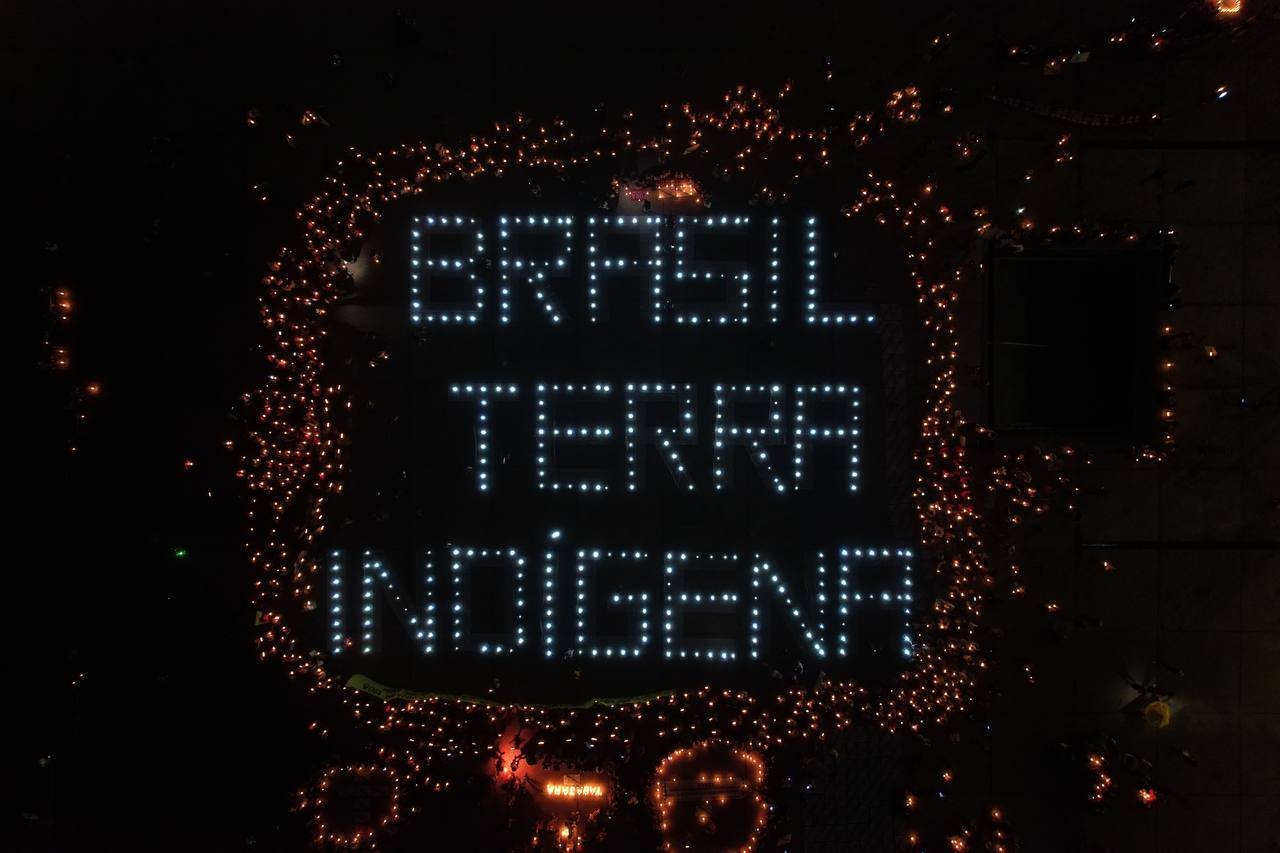
The Vidas Negras com Deficiência Importam Movement – VNDI publicly declares its support for the Brazilian Indigenous struggle against the Marco Temporal (time-frame) thesis, which will be discussed at any moment by the Federal Supreme Court.
The Marco Temporal is a proposal for a time limitation whose purpose is to guide land demarcation processes in Brazil by taking as the starting point the date of promulgation of the 1988 Brazilian Federal Constitution. If this proposal is approved, the original right of Indigenous peoples will be conditioned on proof of the presence of these same peoples in the territories being demarcated specifically on October 5, 1988.
The result of a legislative debate, brought by agribusiness interests and large landowners, the Marco Temporal has already been included in several attempts to amend the Federal Constitution or to create new laws aimed at limiting land demarcation processes. Unsuccessful in the National Congress, this thesis was transplanted to the judiciary, where the emblematic case of the Raposa Serra do Sol reserve, in 2005, stands out, when rapporteur Justice Ayres Britto voted in favor of continuous demarcation of the land, as demanded by Indigenous peoples and the then Lula government. However, in the reasoning of his vote, the justice understood that the time frame to be considered in demarcation processes would be the promulgation of the Federal Constitution itself, as in the following passage:
“It must be seen that our Supreme Law worked with a fixed date: the date of its own promulgation (October 5, 1988) as the irreplaceable reference for recognizing the rights of Indigenous people over the lands they ‘traditionally occupy’. Lands they traditionally occupy, note, and not those they may come to occupy. Nor lands already occupied at other times, but without sufficient continuity to reach the objective milestone of October 5, 1988” – Ayres Britto.
In the same case, in his opinion after reviewing the file, then-Justice Menezes Direito presented 18 institutional theses that limited demarcation, among them the prohibition on expanding Indigenous lands already demarcated.
Since then, the Marco Temporal has been applied by the judiciary with the aim of annulling demarcation processes that had been under way for decades, produced from technical studies that proved these peoples’ connection to these lands. These technical arguments were nullified simply because these peoples were not on the lands on the exact date of October 5, 1988, without considering the obstacles and suffering caused by the expulsion of these original peoples from these lands
In practice, what happens is an erasure of all the institutional violence suffered by Indigenous peoples, from the arrival of the Europeans in our country until October 4, 1988, disregarding that these populations were expelled from their lands and prevented from returning, whether by the landowning rural elite or by the public authorities themselves, but usually in a violent way. This Marco Temporal proposal legitimizes such violence by determining the need to prove the presence of Indigenous peoples at the time of the promulgation of the constituent assembly, ignoring that the history of the original peoples was not born in October 1988. Such erasure is violence.
The risk Brazil faces today is that the STF will recognize the constitutionality of the marco temporal and therefore consider that it must be applied to all land demarcation processes under way, which would lead millions of Indigenous people to have their cultural and sacred ties broken by not having their historical rights recognized. VNDI takes a stand against this violation!
ADVOCACY
VIDAS NEGRAS COM DEFICIÊNCIA IMPORTAM MOVEMENT