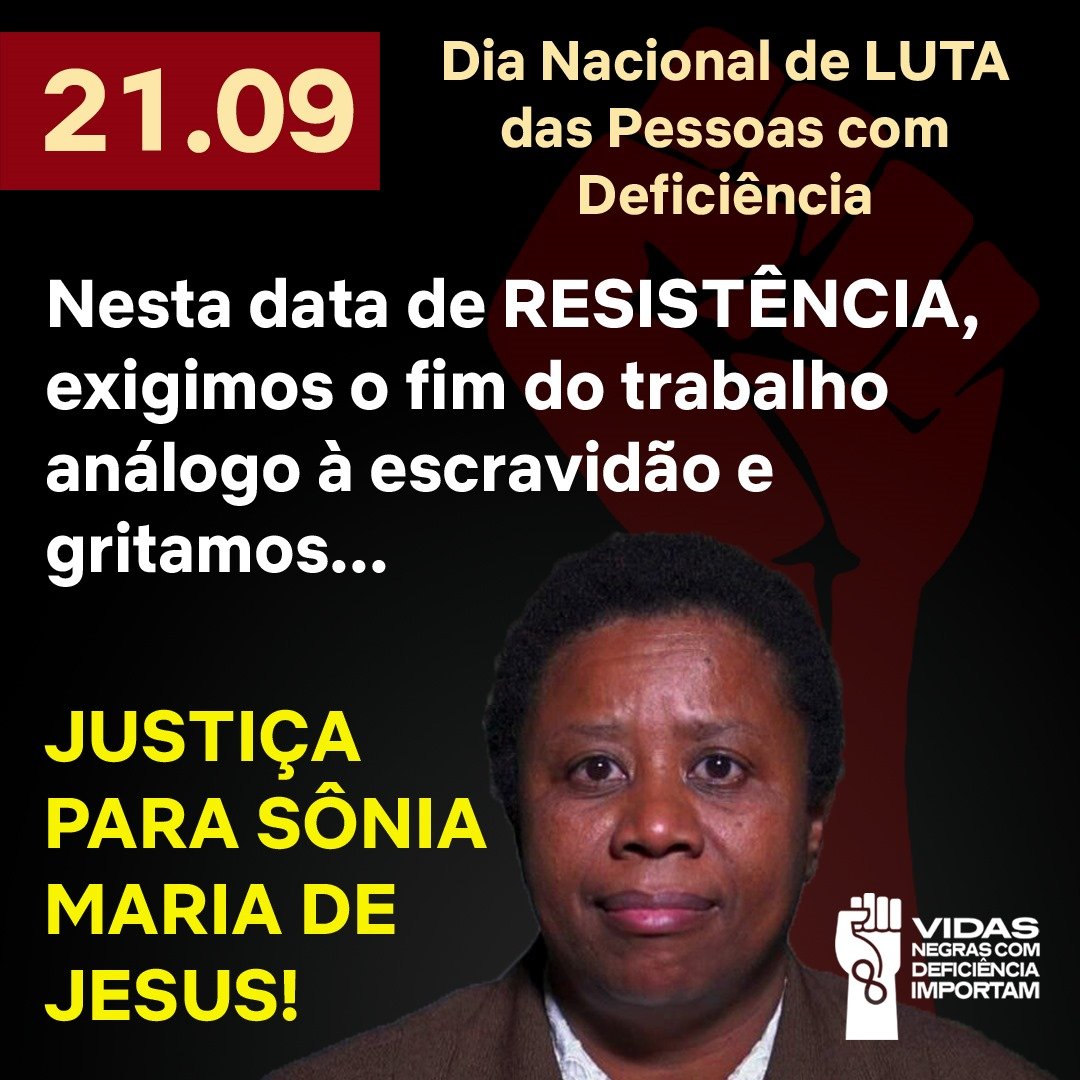
Today, September 21, National Day of Struggle for People with Disabilities, VNDI-Brasil is outraged by the court decision that kept Sônia Maria de Jesus, a Black woman with a disability, in the care of the judge who held her in conditions analogous to slavery for years.
At 50, Sônia is yet another victim of the racism that objectifies and treats Black bodies as tools for manual labor, and of the ableism that seeks to remove any trace of value and dignity. Above all when that body shows some frailty and is unable to defend itself against the various oppressions and violence to which it is exposed.
We see with great disappointment this decision by the STJ and the STF, because they not only contributed to this tragic outcome, but also validate the acts of the judge who decided to “adopt” the victim after years of confinement and mistreatment, even after the investigation.
This reinforces the entire structural racist and ableist system of our society, and devalues all the effort of social movements to combat slave labor and guarantee the rights of Black and poor people who live in extreme vulnerability in our country.
VNDI stands against this court decision and asks for justice for Sônia. May she live her days far from the whole cycle of violence in which she was trapped in the past and have access to a better quality of life.
Understand the case
Sônia Maria de Jesus is 50 years old, a Black woman with a disability (she has bilateral deafness and an intellectual disability), illiterate, and lives in the city of São Paulo. At the age of eight she went to live with the judge’s mother-in-law, with her mother’s authorization, as a way of protecting her from her father’s violence. A year later she moved into the judge’s family home in Santa Catarina, where she lived until she was rescued in 2023.
During the time she lived with the family, there is no data proving that Sônia attended school – regular or specialized – and there are records that her documents were only issued between 2019 and 2021, when she was already forty-six years old.
Last June, she was rescued from the family’s home after doing domestic work for almost 40 years , following a complaint by the Public Labor Prosecutor’s Office in SC. During the operation, the police received reports that Sônia slept in the maid’s room and did household chores without receiving wages or having labor rights. She also ate in the kitchen with the other employees of the house and was not treated the same as the judge’s children, did not enjoy the trips, and had no social life.
After being rescued from the Borba family’s house, the woman was taken to an organization that provides social and psychological assistance. However, the judge filed a civil action in which he claimed that Sônia was like a “daughter”, visited the shelter where she was staying during the investigations and expressed his interest in adopting Sônia, even guaranteeing her inheritance rights.
With this, the STJ authorized her return to the magistrate’s house if she so wished. Which, in fact, ended up happening. A decision reinforced by the STF on the understanding that “The alleged victim of the crime lived as if she were a member of the family”, as cited by Minister André Mendonça in justifying the decision.
She was never reconnected with her biological family, who even came to believe she was dead. Her relatives still live in the same place where she lived with the family, and according to reports her mother searched tirelessly for her daughter until her death in 2016.